Talostolida latior (Melville, 1888)
Burgess' cowry
Talostolida latior is apparently endemic to the Hawaiian Islands.
We found it to be very rare around the main islands, and saw fewer than half
a dozen living specimens over a span of about 13 years. However, several empty
shells on the beach and a living specimen were found on two short (2-4 week)
research trips I made to Kure Atoll
in 1979 and 1980, so it is probably more common in the Northwestern Hawaiian
Islands. It resembles both Talostolida
rashleighana and T. pellucens.
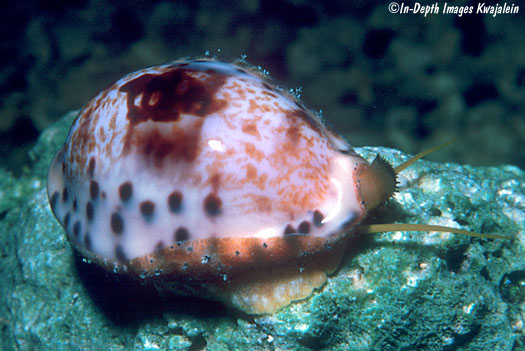
The shell is easily distinguished from both species by animal characteristics,
particularly the mantle papillae, which in T. latior are numerous,
small, and black at the base with branching white tips. T. latior shells
tend to be more deltoid rather than the more elongate T. pellucens,
and the black marginal spotting runs onto the shell's base and up both sides
of the shell into the dorsal pattern; in T. pellucens, the spots are
mostly confined the margin on both sides, rarely extending slightly onto the
base or up the sides. Because of this, occasional specimens of T. pellucens
that are more spotted than others are often figured as T. latior (or
T. burgessi). T. latior tends to be larger and more elongate
than the similar T. rashleighana, and differs in mantle characteristics.
The first specimen below was found at Makaha, Oahu, under a rock at a depth
of about 20m on 13 September 1979.
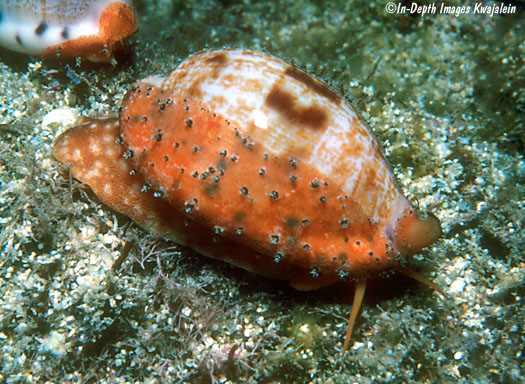
The specimen below was in a ledge
at night at Makua, Oahu, on 27 February 1985. Talostolida latior was
known for some years in Hawaii as Cypraea burgessi, named by E.A. Kay
in 1981. Lorenz (2002) describes the nomenclatural history of this species and
its relatives.

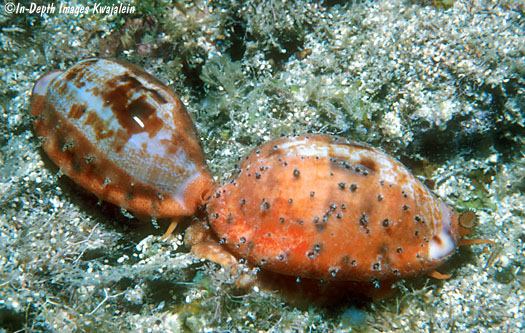
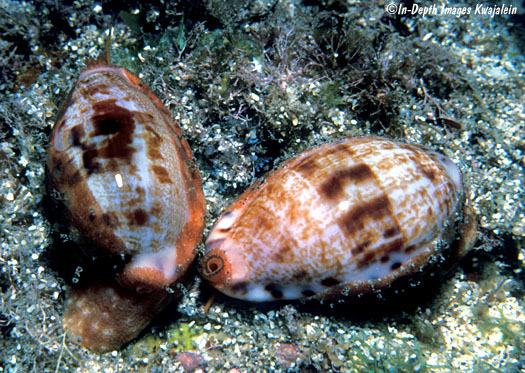
The two photos below show specimens
of T. pellucens and T. latior together. They were not found
that way, but placed together for comparison. Some years ago, a well-known malacologist
who shall here remain nameless used a photo of mine (without permission I might
add) from this same photo session in an article to substantiate his argument
that the two species, then known as Cypraea alisonae and C. burgessi,
were the same. He went further in the article to ridicule and belittle the authors
of those two species, E.A. Kay for burgessi and Burgess for alisonae.
He seemed to think that since both shells were photographed together, that was
evidence they were not separate species. Had the author of that article the
courtesy to ask me for permission to use the photo, I could have told him that
the animals were not in fact found together. It just goes to show you cannot
necessarily believe everything you read in a publication.


REFERENCES:
Lorenz, F. 2002. New Worldwide
Cowries. Conchbooks, Hackenheim, Germany. 292pp.
Created
25 July 2010
Return
to Hawaiian cowries
Kwajalein Underwater home