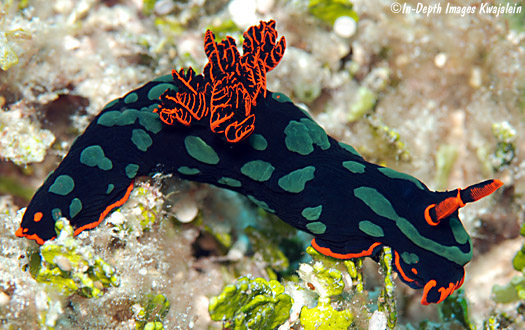
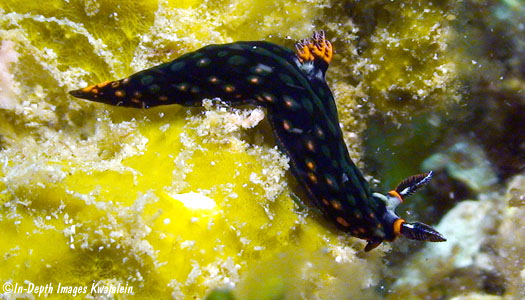
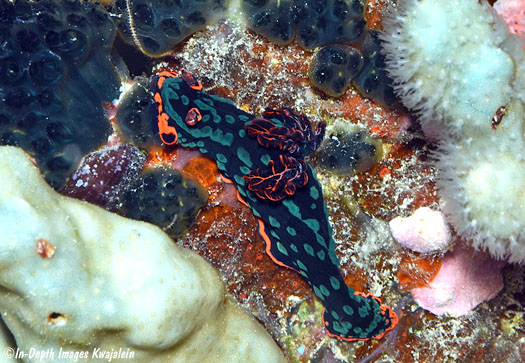
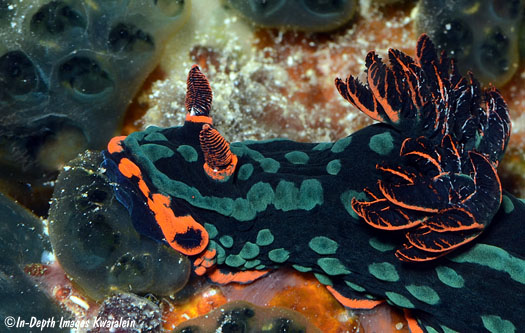
This has to be one of the most striking nudibranchs around. Nembrotha kubaryana is uncommon at Kwajalein Atoll but not rare. Despite extensive searching, it was never observed at Enewetak Atoll. The dayglo red rhinophores, foot margin, and (usually) gills are hard to miss, especially in a nudibranch that can often exceed 50mm in length. At Kwajalein, it can be found on lagoon pinnacles and interisland reefs, but is also present on the top of the seaward reef front. It lives in ledges and under rocks and is sometimes seen crawling out in the open during the day. In normal daylight, the colors are unmistakable and vivid, and it seems obvious that the fiery red must function as warning coloration. This species eats a dark green colonial tunicate we have tentatively identified as Sigillina signifera and which appears to be the same tunicate eaten by the similar Nembrotha cristata. Usually we see only one or two specimens of N. kubaryana at a time, unlike N. cristata, which sometimes seems to congregate in larger numbers. Nembrotha kubaryana was first reported in the Marshalls from Kwajalein Atoll by Johnson & Boucher (1984).
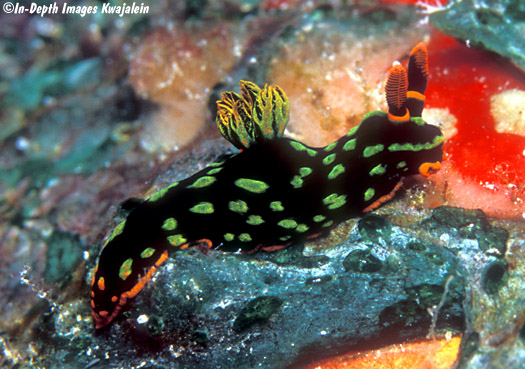
Chowing down on dark green colonial tunicates.
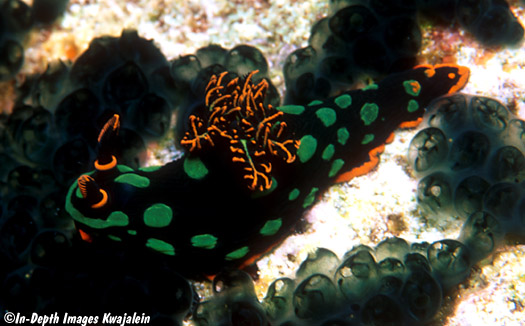
This species can be difficult to photograph. While the red shows up well on film, the black body with dark green spots often seems to suck up the light from a photographer's strobe. The shade of the green does vary among individuals, so one of the tricks to getting good photos is to find a specimen with lighter colored spots.
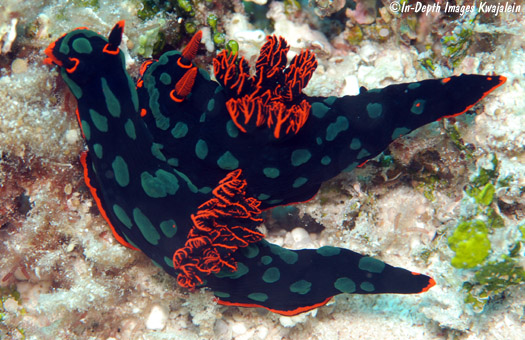
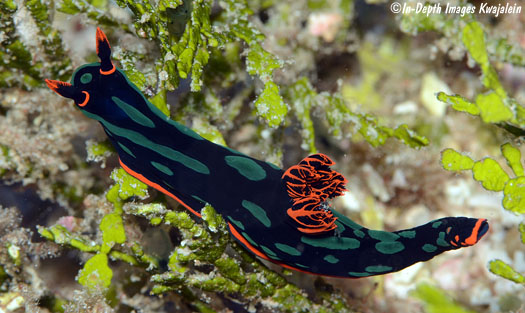
The one below was depositing an egg mass on a clump of Halimeda algae on a lagoon reef.
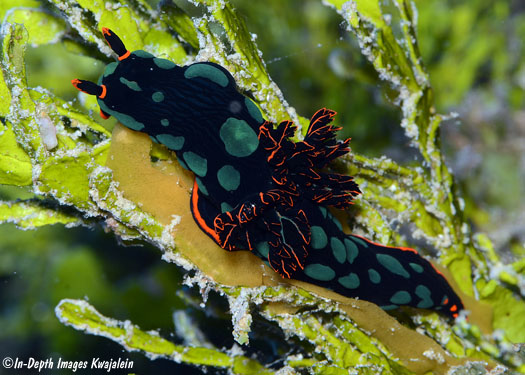
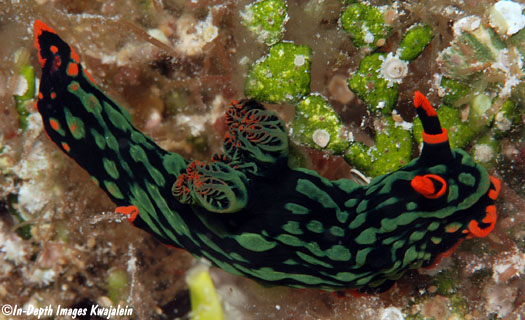
The two different specimens below have more green on the body and red on the tail, but the gills are mostly green.
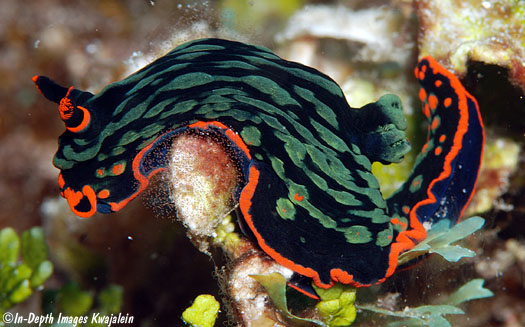
The white on and around the rhinophores and gills is unusual for Marshall Islands specimens of this species. The two copulating immediately below were also very small specimens, only about half the length of those we normally see. It is curious that with all the normally colored ones around, these two that were both unusually small and with an odd coloration managed to find each other and come together to mate. It is almost enough to make one think these could be something closely related but different.
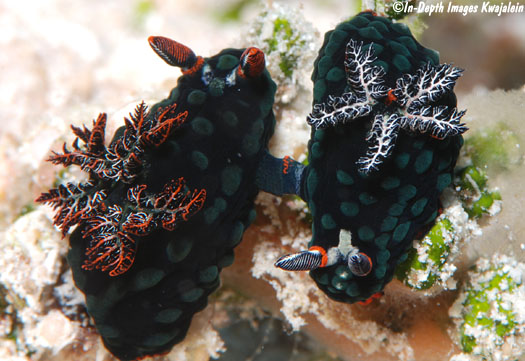
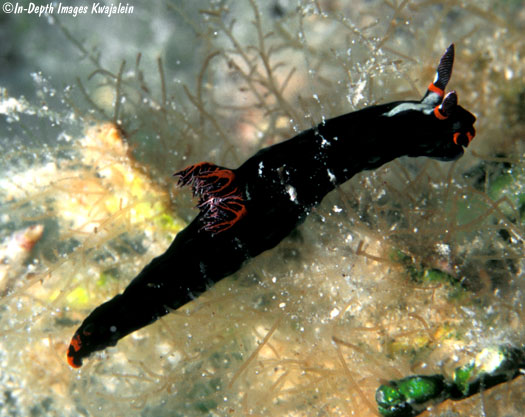
This very dark and rather small specimen is similar to the two above with its distinct white markings on the head and rhinophores. Its body was so dark the green could hardly be seen. It was found on a Kwajalein Atoll lagoon reef in 8m of water on 18 June 2007.
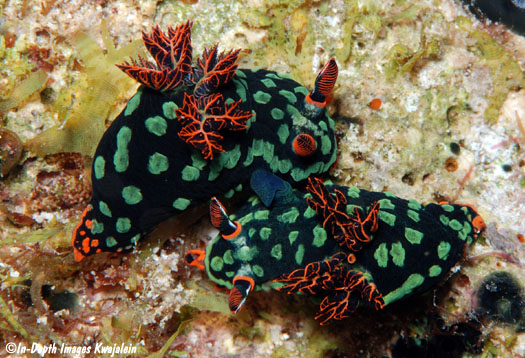
The two below were also unusually small but mature and mating. These have a trace of the white color seen in the specimens above, particularly on the posterior edge of the rhinophores. They were on a lagoon pinnacle reef where several more typical Nembrotha kubaryana were also seen.
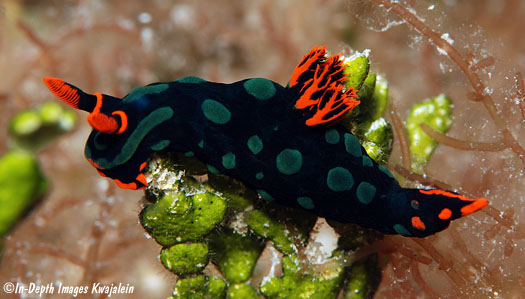
A specimen found on a lagoon reef on 3 September 2011 had no trace of white markings on the head.
One more of the forms with white markings on the head, this one also had more development of red spots along the majority of the body. This one came from the same lagoon reef where the other white-headed ones were found.
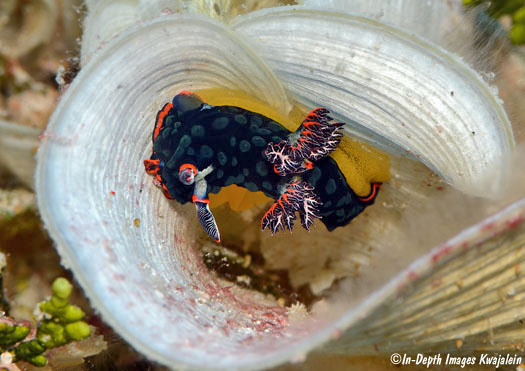
Another small white-headed specimen, this time with an egg mass within the curl of a Padina plant.
Another one feeding on the green tunicates on a lagoon pinnacle on 15 September 2013.
Created 3 January 2007
Updated 27 September 2013