Gymnodoris cf alba (Bergh, 1877)

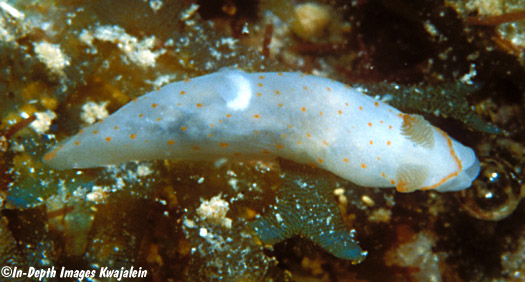
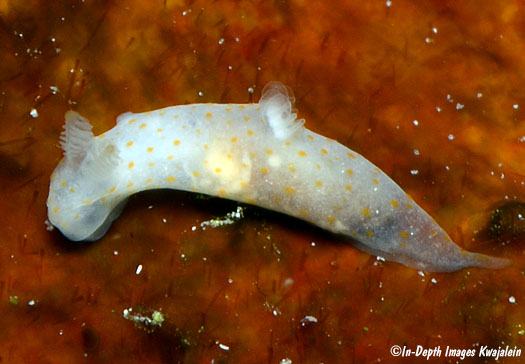
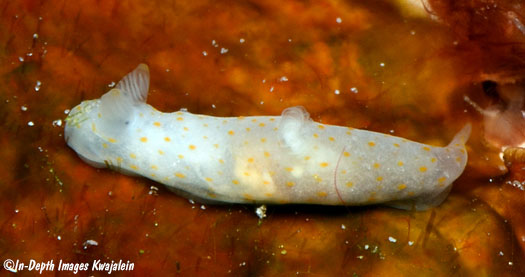
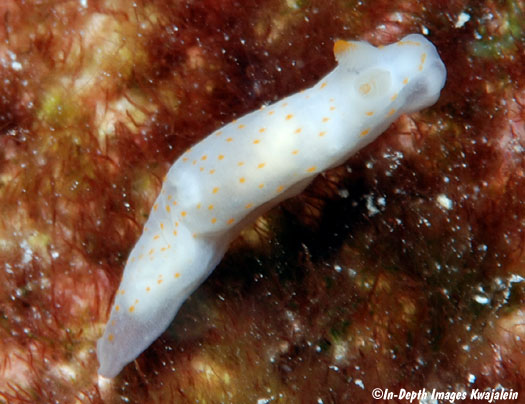
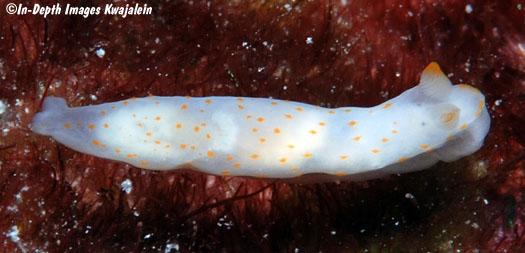
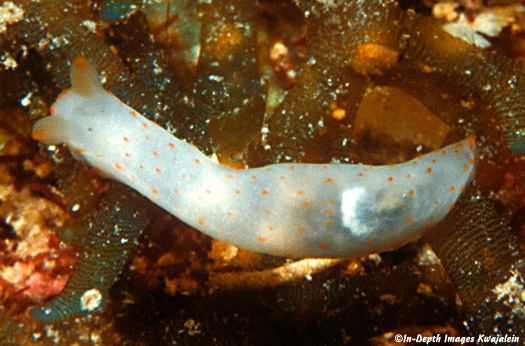
This animal is similar to the description of Gymnodoris alba but there are some differences. In fact, it is not clear that all the photos below represent the same species. The first two shots differ from the last two in that the anterior end of the body is fringed with a distinct and somewhat pointed orange rim. The last pic has more rounded anterior ends and lacks the orange rim. Also, the first two have more distinctly orange pointed rhinophores. All the animals below look similar in the horseshoe shape of the gills, which are colored bright white along the anterior curve.

The identification as G. alba is also questionable. Many species of Gymnodoris are deceptively similar with white bodies and orange spots. A search of the web shows what have to be several species listed under this name; despite the general similarity in color, they are almost certainly not all the same.. The Marshalls specimens (some of them anyway) are similar externally to those reported in Kay & Young (1969) from Hawaii, but the radula is quite different. A 9mm specimen from the Marshalls had a radula with a formula of 27x19.0.19, although it might be better to say 27x18.1.0.1.18 since the innermost tooth was so distinctly different from the rest. The inner tooth is hook-shaped and large, 110 µm in length, and quite a bit larger than the rest of the teeth in the row, which maxed out at about half that length in the first few teeth. In Kay & Young's specimen, the innermost tooth was smaller than the succeeding teeth. The larger first lateral tooth is similar to published descriptions of the radulae of Gymnodoris bicolor in Kay & Young (1969) and Gymnodoris citrina in Young (1967). However, we have seen numerous specimens of G. citrina in the Marshalls and several G. bicolor in Hawaii and externally the current species appears clearly different. Further, Young in 1967 noted that a 22mm specimen of G. bicolor in Hawaii had an innermost tooth 120 µm long while a 6mm specimen of G. citrina from Enewetak's first lateral was an even larger 142 µm. So ours are certainly not likely to be G. citrina and I would think a couple of G. bicolor, one twice the length of the other, would not have innermost teeth nearly the same size. .

One of the items in the diet of this species would appear to be gastropod eggs masses. The gut of the dissected specimen was filled with small, white planospiral shells, each about 300 µm in diameter.

In the Marshall Islands, this species is known from six specimens (if in fact they are all the same) found at Enewetak and Kwajalein Atolls. Three of those ranged from 8 to 9mm in length, and all were found under dead coral or in Halimeda patches on lagoon reefs and pinnacles at depths of 7 to 10 meters.
Created 1 January 2007
Updated 18 April 2008

References:

Kay, E.A. & D.K. Young. 1969. The Doridacea (Opisthobranchia; Mollusca) of the Hawaiian Islands. Pacific Science 13(2):172-231.

Young, D.K. 1967. New Records of Nudibranchia (Gastropoda: Opisthobranchia: Nudibranchia) from the central and west-central Pacific, with a description of a new species. Veliger 10(2):159-173.