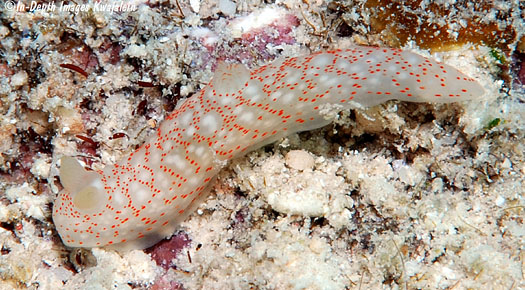
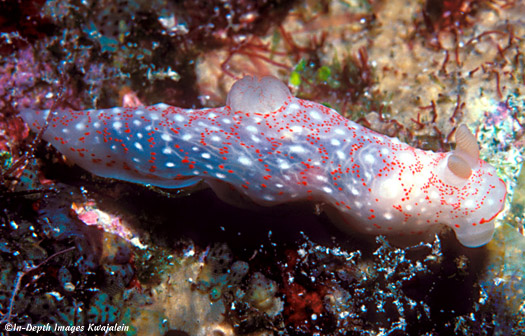
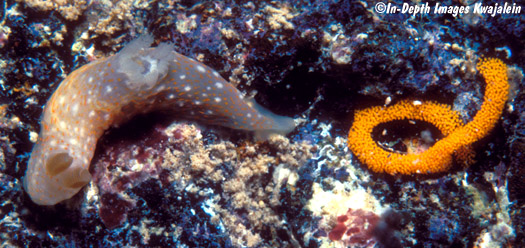
When we first found this species, we thought it might be a form of Gymnodoris okinawae, which we had previously seen in Hawaii. However, the radula is quite different; in particular, the longest teeth of the Marshall Islands animals are in the middle of the half row rather than increasing in length to the outermost, as in the Japanese and Hawaiian G. okinawae (Baba, 1936; Kay & Young, 1969). At least 20 specimens have been observed at Enewetak, Kwajalein and Majuro Atolls ranging in length from 7 to 25mm. They live on a variety of lagoon and seaward reefs at depths of 3 to at least 15 meters. The first one below was photographed on a Kwajalein Atoll lagoon reef on 8 February 2009. Gymnodoris sp. e149 was first reported in the Marshalls from Enewetak and Kwajalein Atolls as Gymnodoris okinawae by Johnson & Boucher (1984).
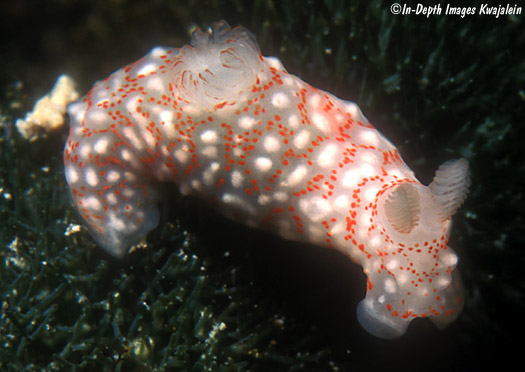
Next is an animal from Enewetak Atoll.
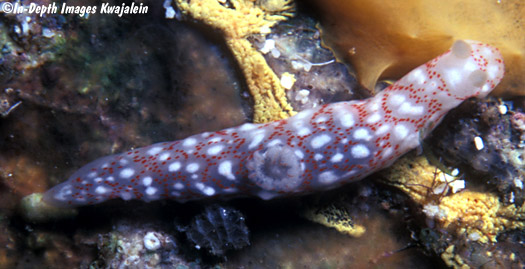
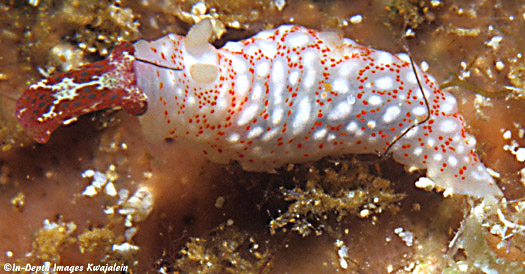
The animal below was found at Majuro by Ken Cone and Beth Van Zummeren.
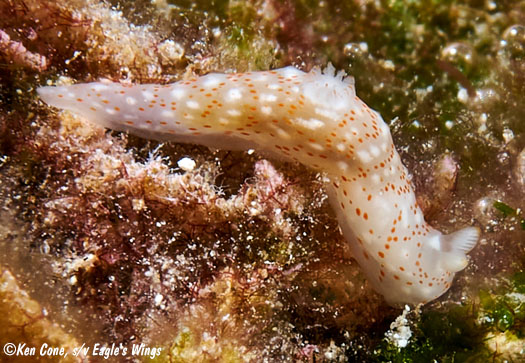
One external difference from G. okinawae is the distinct arrangement of orange spots forming a network around the low white pustules. In G. okinawae (see the bottom of this page), the orange spots and sometimes short lines are more randomly scattered over the dorsum.
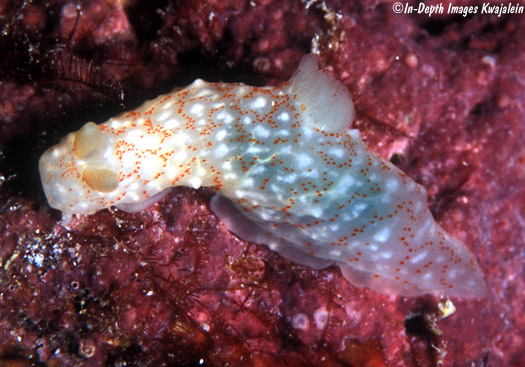
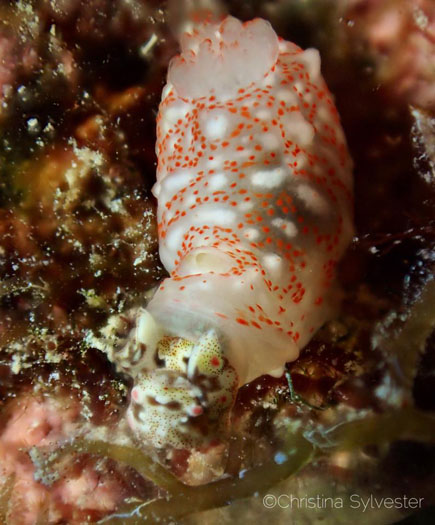
Another difference with Gymnodoris okinawae may be in the diet. Gymnodoris okinawae is reported by Kay & Young (1969) to eat various species of the sacoglossan genus Elysia. Gymnodoris sp. e149 was not interested in offered Elysia spp, but would readily eat small cephalaspideans such as Odontoglaja in the photo below. However, this is not conclusive, as the Hawaii Sea Slugs site reports that Gymnodoris okinawae did eat a small cephalaspidean, Colpodaspis thompsoni, along with species of Elysia in a holding dish.
The photo below by Christina Sylvester at Kwajalein shows Gymnodoris sp. e149 engulfing an Odontoglaja guamensis.
For comparison, a photo of a Hawaiian Gymnodoris okinawae with its egg mass is provided below.
Created 1 January 2007
Updated 24 May 2021