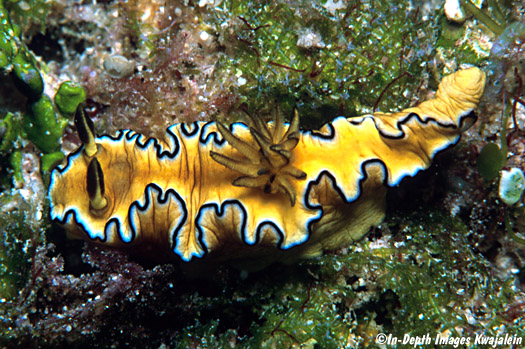
Doriprismatica atromarginata is reasonably common in the Marshalls, but only if you know where to look for it. At Kwajalein Atoll, they most commonly live along the oceanside of windward atoll reefs, in ledges and caves up in the groove and spur system, a habitat they share with the even more common Glossodoris rufomarginata. This is an extremely rough area; we can get there only when both the winds are light and the north or east swell is very small. It is almost hard to believe that the nudibranchs can adhere to the rocks or to their sponge prey strongly enough to keep from being ripped off and washed across the reef during the extreme conditions normally present. The sponge colonies seem to be more at risk. As noted on the Glossodoris rufomarginata page, clumps of prey sponge are sometimes ripped off the substrate and rolled across the reef into the lagoon, where they come to rest on the lagoon slope. It seems a fairly high proportion of these clumps bear nudibranch riders, who seem to make the trip across the reef without visible damage. Unfortunately, their sponge prey does not naturally occur on the lagoon slope, so once the nudibranchs finish off whatever colony they have ridden across, they have to scatter in hopes of finding another clump that has rolled across. During the windy season this appears to happen often, since clumps of the sponge on the lagoon slope are not rare. During the windy season, it is not unusual to find a dozen or more of both D. atromarginata and G. rufomarginata on a single lagoon slope dive, sometimes both species on a single loose clump of sponge. But this is not the only atoll habitat for this species. Occasionally specimens can also be found on lagoon reefs or pinnacles, or even on the seaward slope of the leeward side of the atoll. Specimens we've seen have ranged up to about 50mm in length. The specimens we show here may actually represent more than one species of nudibranch. Doriprismatica sibogae is very similar to D. atromarginata, and the two can be positively differentiated only by looking at their internal anatomy. Doriprismatica atromarginata was first reported in the Marshalls as Casella atromarginata from Bikini Atoll by Marcus (1965). We also have seen specimens at Enewetak and John and Lynette Flynn and Ken Cone and Beth Van Zummeren have observed them at Rongelap.
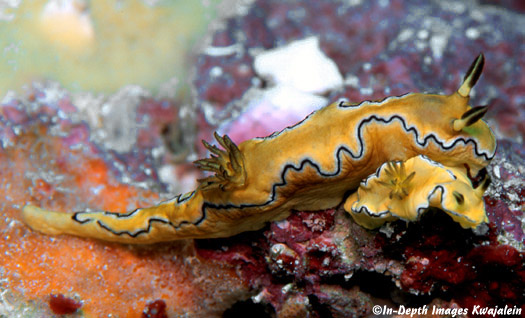
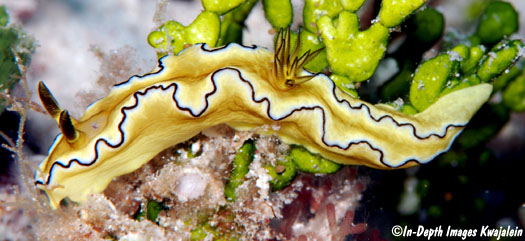
The 25mm specimen pictured below carried a pair of purplish commensal copepods, one with a darker colored X shaped mark. One of the copepods is right in front of the gills; the other is a bit towards the tail.
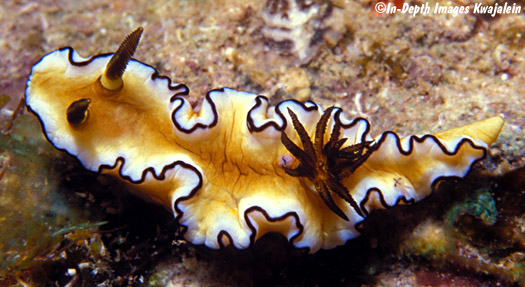
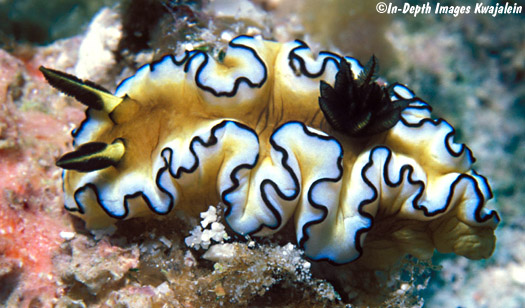
The two below are at rest, showing the highly convoluted black line at the margin of the dorsum.
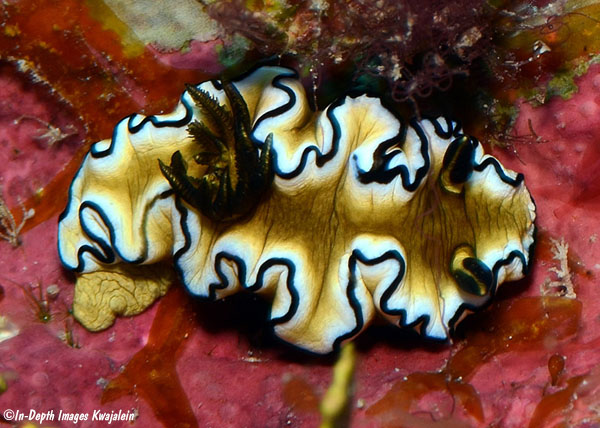
The one below had a bit unusual coloring for Doriprismatica atromarginata from this area, but we think it is still the same species.
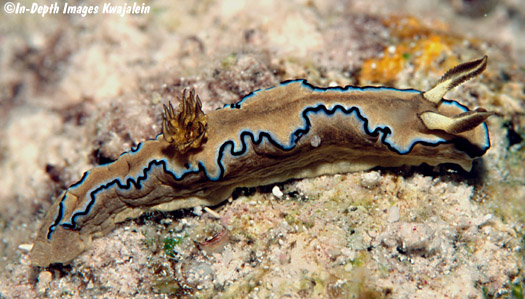
The specimen below was a small juvenile measuring about 12mm and was found at a depth of 5m under a rock on the Kwajalein Atoll seaward reef on 1 June 2009. One or more of the specimens below may actually be Doriprismatica sibogae.
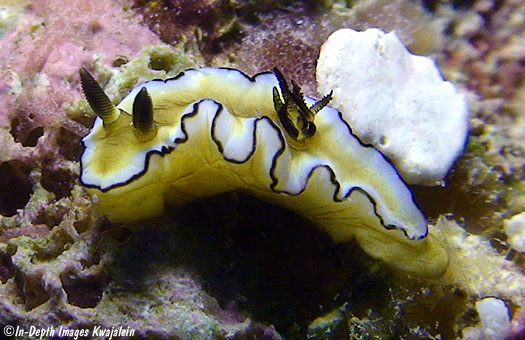
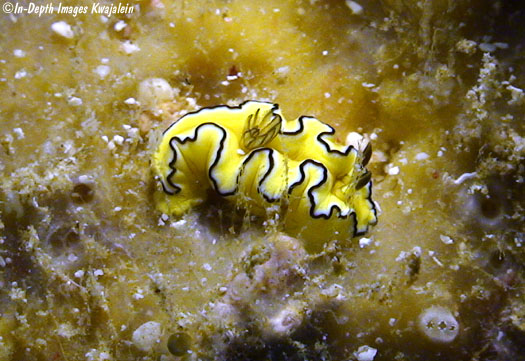
The specimen below was on and apparently eating a yellow sponge. Normally it is on a darker gray or green sponge in its typical habitat on the shallow seaward reef. This specimen may have washed across the reef to the lagoon side of Kwajalein Atoll and was eating whatever it could find. The animal was observed on 9 August 2009.
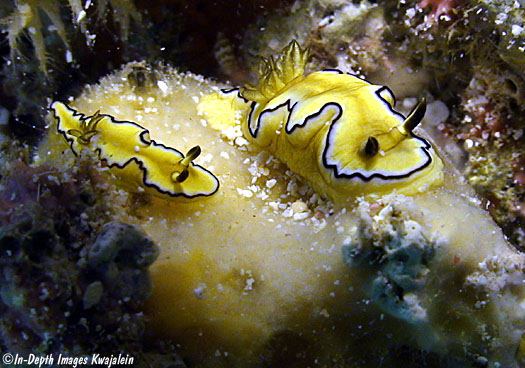
The pair below was found on yet another sponge under a rock on a shallow Kwajalein Atoll lagoon reef on 20 September 2009.
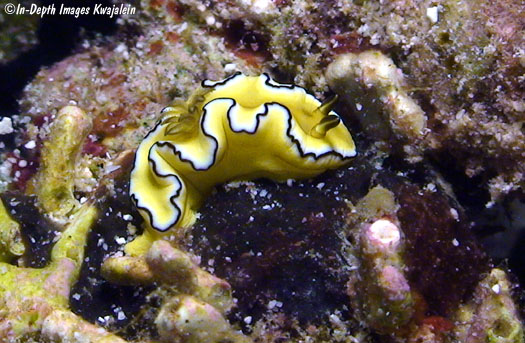
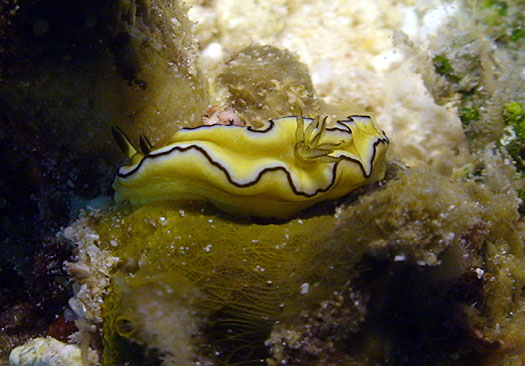
The next two photos also show specimens apparently eating different sponges. Both were on Kwajalein Atoll lagoon reefs, the upper on 4 July 2009 and the lower on 25 May 2009.
Large waves in January of 2012 sent many chunks of sponge across the reef from the seaward reef surge channels. On dives along the lagoon side of that reef then we found lots of sponge chunks, many occupied by Doriprismatica atromarginata or G. rufomarginata. The sponge chunk below, still bearing pieces of a Stylaster coral abundant in the seaward channels, measured maybe 20cm in diameter, supported six D. atromarginata and one G. rufomarginata.
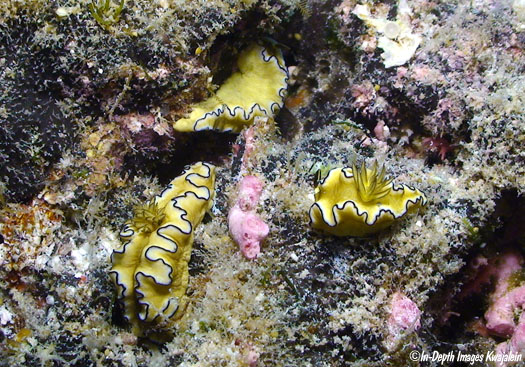
Another with four D. atromarginata.
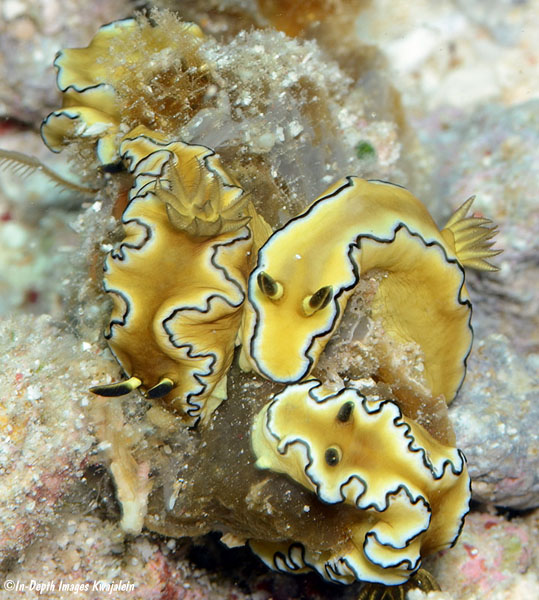
In the ledges in shallow spurs and grooves on the ocean side of the east reef, specimens will often cluster on their prey sponge.
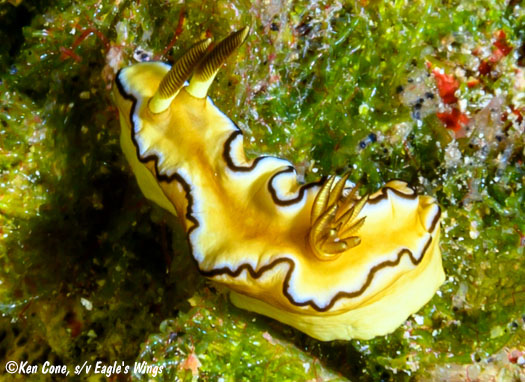
The photo below by Ken Cone is from Rongelap.
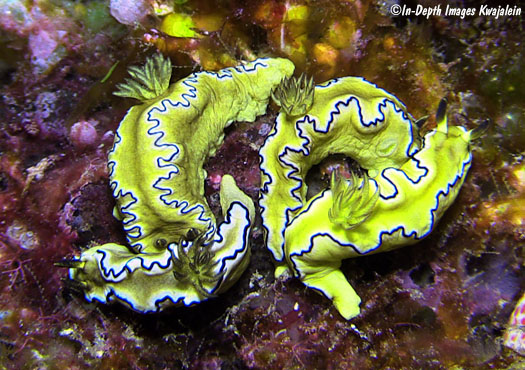
A review by Johnson & Gosliner (2012) notes that the genus Doriprismatica is a preliminary designation and will likely be changed after further study.
Created 3 January 2006
Updated 7 November 2021